


One, the economist Jean Pisani-Ferry, defines himself as a social democrat; the other, Jean-Louis Bourlanges, a former member of both the European Parliament and the Assemblée Nationale, as a Christian democrat. Aged 74 and 79 respectively, both belong to the generation that saw the end of the Cold War as a unique opportunity for Europe and for democracy. Both, as intellectuals, consistently worked to seize that opportunity.
By chance, two ministers from an soon-to-collapse government presented them with the insignia of Officer of the Légion d’Honneur in Paris, 24 hours apart: Eric Lombard, minister of economy and finance, decorated Pisani-Ferry on September 4; and Jean-Noël Barrot, minister for Europe and foreign affairs, presented the honor to Bourlanges on September 5.
Before audiences of experts, diplomats and high-ranking civil servants – and in the presence of several government members, including Prime Minister François Bayrou for Bourlanges, and Education Minister Elisabeth Borne for Pisani-Ferry – the two honorees delivered, without consulting each other but with the same unflinching clarity, a blunt judgment on the legacy of the Trente Glorieuses, the three decades of postwar growth in France, and the hopes raised by the seismic shifts of the early 1990s, whether in globalization, European integration, environmental action, multilateralism, or the role of centrism in democracy. Le Monde is publishing excerpts from their speeches.
Pisani-Ferry’s speech
“I have things to say.” From the outset, in the grand Michel-Debré Salon at the Ministry of Economy and Finance overlooking the Seine, Pisani-Ferry announced that his speech would not be conventional. An emeritus professor at Sciences Po, former head of the Center for Prospective Studies and International Information (CEPII), former general commissioner of France Stratégie and columnist for Le Monde, he is a highly respected center-left economist.
In 2023, at the request of then prime minister Elisabeth Borne, he submitted a report on the economic impact of climate action, which estimated that an additional €34 billion in public investment would be needed each year until 2030.

In his speech, he bitterly reflected on the three main battles of his life: opening up the world, Europe, and climate action. “On all of the issues that have defined my life, we are regressing,” he lamented. Having participated in Emmanuel Macron’s 2017 presidential campaign, he regretted the president’s shift to the right. He described himself as “too disappointed to still belong, but too faithful to truly break away.”
Bourlanges’ speech
The following evening, in the Salon de l’Horloge at the Ministry of Foreign Affairs, the very place where Robert Schuman delivered his founding declaration on Europe 75 years ago, Bourlanges delivered a similar verdict of failure. A witty and humanist figure, he served for 18 years in the European Parliament before being elected to the Assemblée Nationale in 2017, where he chaired the Foreign Affairs Committee.
Speaking in front of Bayrou, who would still be prime minister for three more days, Bayrou’s predecessor Michel Barnier, and the ambassador of Ukraine, Bourlanges put his own generation, the postwar “boomers,” on trial: “My generation received an immense legacy from the one that preceded it and, as I prepare to lay down my burden, I do indeed feel that the men and women of my time were not fully up to this inheritance.”
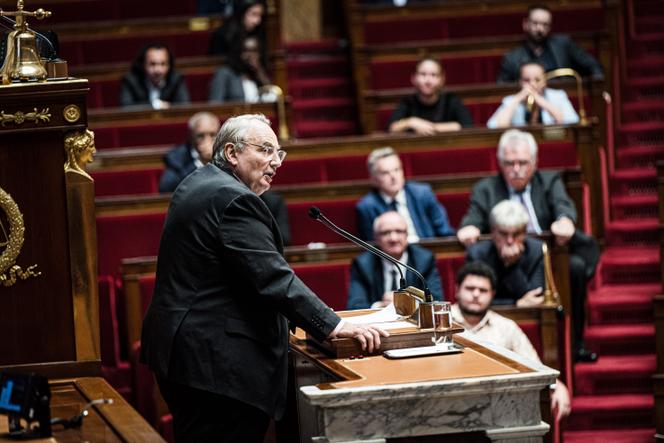
Bourlanges called on future generations to draw inspiration from the generation that preceded his, thanks to whom “never in the history of humanity, and nowhere else on Earth, have men and women enjoyed such long years of peace, freedom, prosperity and solidarity.” Reflecting on the disappointments of the past 30 years, he condemned “a crisis of all forms of solidarity”: “We have allowed every divide to widen: territorial, community, generational, environmental and gender. We have failed to unite, to pass on, or to invest.”
Europe, for which he fought long and hard, is under a mortal threat, he argued, criticizing European leaders who, believing they can appease Donald Trump, give in to his demands: “We are in a full-fledged Stockholm syndrome.” He regretted that his generation was unable to revisit the European project or overcome its divisions; the values opposed to those of Europe “are gaining ground everywhere.”
Fonte: Le Monde