


LETTER FROM LAOS
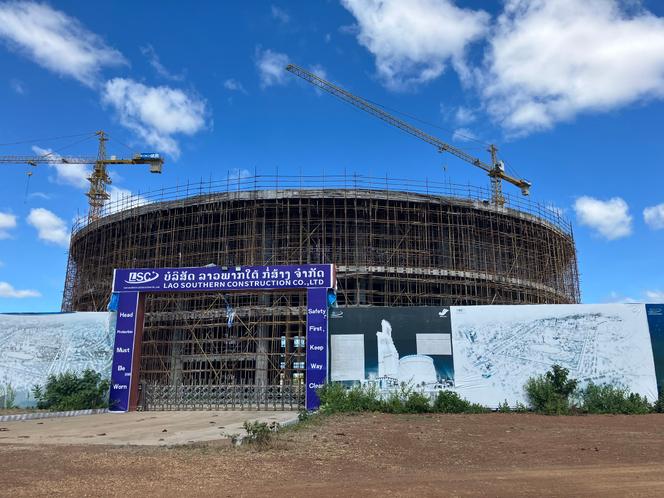
It’s a desolate stretch of countryside in southern Laos, not far from the Khone Falls, the roaring cataracts that block the Mekong River for several dozen kilometers just before the border with Cambodia. Two immobile cranes tower over a vast concrete rotunda surrounded by scaffolding. The structure, 100 meters in diameter and three or four stories high, seems far too advanced to have been abandoned, but the absence of workers – or even a guard – and the faded promotional images on the fences signal that this improbable project has ground to a halt.
This footage, in fact, reflects the vision of a futuristic city straddling two branches of the Mekong: a constellation of marinas, business parks, and recreational sites, all dominated by twin towers shaped like the khène, the traditional Lao mouth organ. And the half-built circular structure? It was to be one of two future 13-story hotels intended to resemble a basket of sticky rice.
This is the ‘Siphandone Special Economic Zone,’ an area of 100 square kilometers whose development was entrusted in 2018, for 99 years, to Chinese investors based in Hong Kong. The goal was to turn this remarkable section of the Mekong, known for its river archipelago, the 4,000 Islands (Si Phan Don in Lao), into a “tourism and digital industry hub” powered by cheap electricity from a dam built by Chinese giant Synohydro on one branch of the river, operational since 2020.
You have 74.86% of this article left to read. The rest is for subscribers only.
Fonte: Le Monde