



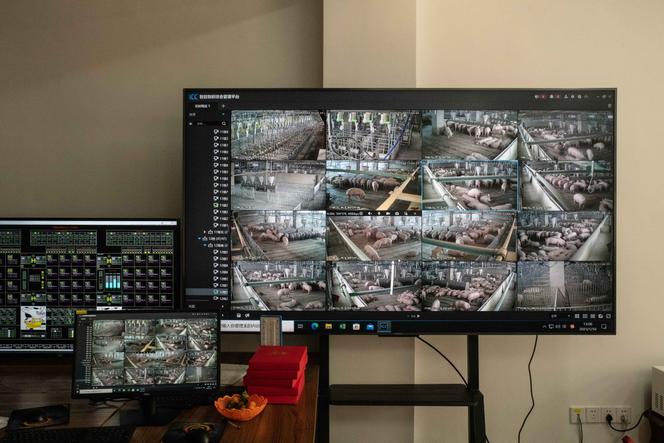
“I no longer have to fear losses, I can finally sleep soundly!” exclaimed Zhang Yanbo, as quoted in a December 16 article published on Sina, a Chinese news site. A livestock worker at the industrial giant Muyuan, he saw new hope after his family farm was wiped out by the African swine fever outbreak in August 2018. “The era of traditional pig farming is over. Now, everything is standardized and smart,” added Yang Manman, his colleague and a former small-scale farmer, who was finally able to pay off her debts.
Behind this reassuring story of professional reinvention – reminiscent of a promotional feature – lies a transformation of unprecedented brutality. In less than three years, at the direction of the central government, China shifted from predominantly small traditional pig farms (the majority in 2018 with fewer than 500 pigs per year) to giant pig factories, each capable of housing nearly 500,000 animals, where ventilation, heating, health monitoring, feeding and waste removal are fully automated.
This transition resulted from the spread of the virus – for which no effective vaccine exists – and the ensuing mass culling. China’s pig herd fell from 428 million at the end of 2018 to 310 million a year later, a drop of 27.5%. In response, pork prices soared and China became dependent on foreign producers, causing anxiety in a country where pork is a food staple.
You have 68.12% of this article left to read. The rest is for subscribers only.
Fonte: Le Monde