


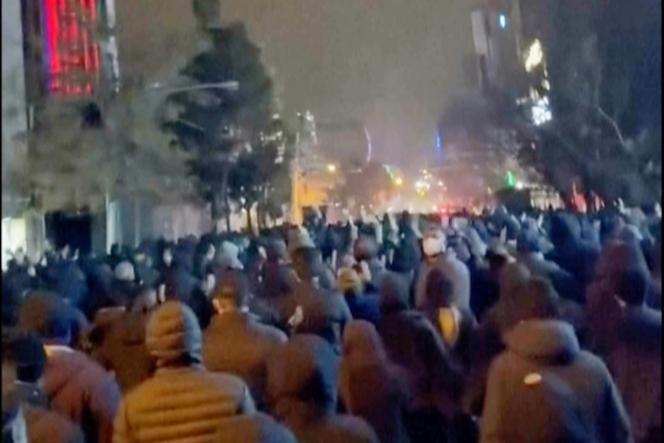
Iranians took to the streets in new protests against the country’s clerical authorities overnight despite an internet shutdown, rights groups warned on Sunday, January 11, that Iran’s authorities were committing a “massacre” to quell the demonstrations.
The protests, initially sparked by anger over the rising cost of living, have now become a movement against the theocratic government that has ruled Iran since the 1979 revolution, and they have already lasted two weeks. The mass rallies are one of the biggest challenges to the rule of Supreme Leader Ayatollah Ali Khamenei, 86, coming after Israel’s 12-day war against Iran in June, which was backed by the United States.
In Tehran, an AFP journalist described the city as being in a state of near paralysis. The price of meat has nearly doubled since the start of the protests, and, while some shops are open, many others are not. Those that do open must close at around 4:00 or 5:00 pm, when security forces deploy in force.
Videos posted to social media showed large crowds taking to the streets in new protests in several Iranian cities including the capital Tehran and Mashhad in the east, where images showed vehicles set on fire.
Several videos to have been shared, which have not been verified by Agence France-Presse (AFP), allegedly showed relatives in a Tehran morgue identifying the bodies of protesters killed in the crackdown.
‘A massacre’ amid an internet blackout
The videos have filtered out despite a total shutdown of the internet in Iran, which has rendered normal communication with the outside world via messaging apps impossible. The internet blackout “is now past the 60 hour mark (…) The censorship measure presents a direct threat to the safety and wellbeing of Iranians at a key moment for the country’s future,” the internet monitor Netblocks said early on Sunday.
On Saturday, mobile phone lines appeared to have gone down as well, rendering nearly all communication impossible.
The US-based Human Rights Activists News Agency said it had confirmed the deaths of 116 people in connection with the protests, including 37 members of the security forces or other officials. Yet activists warned that the shutdown was limiting the flow of information and the actual toll risks being far higher.
The US-based Center for Human Rights in Iran (CHRI) said it had received “eyewitness accounts and credible reports indicating that hundreds of protesters have been killed across Iran during the current internet shutdown.” “A massacre is unfolding in Iran. The world must act now to prevent further loss of life,” it said.
It said hospitals were “overwhelmed,” with blood supplies were running low, and that many protesters had been shot in the eyes in a deliberate tactic.
‘Significant arrests’
In comments to state TV late on Saturday, Interior Minister Eskandar Momeni insisted that acts of “vandalism” were decreasing, and warned that “those who lead the protest towards destruction, chaos and terrorist acts do not let the people’s voices be heard.”
National police chief Ahmad-Reza Radan said the authorities had made “significant” arrests of protest figures on Saturday night, without giving details on the number or identities of those arrested, according to state TV.
Iran’s security chief Ali Larijani drew a line between protests over economic hardship, which he called “completely understandable,” and “riots,” accusing them of actions “very similar to the methods of terrorist groups,” the Tasnim news agency reported.
US support for the protests
Reza Pahlavi, the exiled son of Iran’s ousted shah, who has played a prominent role in calling for the protests, called for new actions later on Sunday. “Do not abandon the streets. My heart is with you. I know that I will soon be by your side,” he said.
US President Donald Trump has spoken out in support of the protests and threatened military action against Iranian authorities “if they start killing people.”
In response, on Sunday, Iran’s parliament speaker Mohammad Bagher Ghalibaf said Iran would hit back if the US launched military action. “In the event of a military attack by the United States, both the occupied territory and centers of the US military and shipping will be our legitimate targets,” he said in comments broadcast by state TV. He was apparently also referring to Israel, which the Islamic Republic of Iran does not recognise and considers to be occupied Palestinian territory.
Fonte: Le Monde