



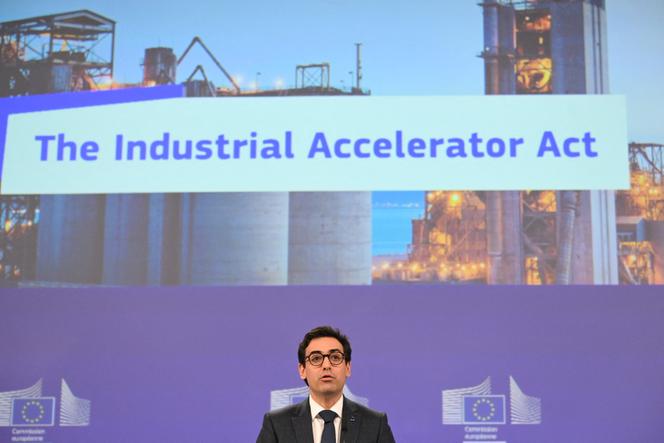
For years, the concept of European “industrial sovereignty” remained little more than empty rhetoric, never leading to any real policy to protect and promote manufacturing and production on the continent. With the Industrial Accelerator Act, presented on Wednesday, March 4, the European Commission has finally proposed an antidote to deindustrialization. Today, the European Union’s 27 member states have no choice: Facing economic decline and strategic vulnerability in a world that is increasingly shaped by power struggles, they cannot remain stagnant.
The act aims to promote European preference in industrial policy, by making access to public procurement markets and state subsidies conditional on strict local production requirements. This “Made in EU” principle would apply to decarbonized heavy industrial production (aluminum, cement, etc.), green technologies (wind turbines, electrolyzers, heat pumps, batteries, photovoltaics, etc.), nuclear power, and electric and hybrid vehicles – which would have to include 70% of locally sourced components (excluding the battery).
For the EU, this is a double break with the past. Beyond implementing the principle of European preference, the act would enshrine industrial policy as a tool for trade policy. By introducing the concept of reciprocity, the act sends a clear message to the EU’s trade partners: Countries that close off their public procurement markets will no longer enjoy free access to Europe. This marks a paradigm shift for a union built on the idea of free trade – sometimes to the detriment of its own interests.
As with all European advances, this one underwent a difficult process. The act was postponed many times and subject to heated debates before a consensus was reached. That consensus required broadening the definition of “Made in EU” to include dozens of partner countries, though this risks diluting the initial ambition. Some key sectors also did not meet the stringent requirements needed for a true industrial revival strategy: For example, steel, which is required to be low-carbon, but not necessarily of European origin.
External pressures
Above all, several political obstacles remain. The bill still needs approval from the EU member states and the European Parliament, where there are persistant divisions. This dissension breaks down according to the influence the industrial sector holds in each country, the countries’ trade surplus levels and their vulnerability to potential retaliatory trade measures. External pressures, especially from the United States and China, risk pushing some to try to water down some measures, which they might see as overly protectionist.
Finally, the Industrial Accelerator Act poses an existential question: Is Europe politically ready to follow through on the measures it proposes at the regulatory level? Making access to its market conditional, monitoring foreign investments and imposing industrial requirements all require an ability to monitor, sanction and maintain coherence – capacities the EU has not always demonstrated.
Depending on the outcome, the act would reveal how the EU’s member states truly want Europe to look. Do they want it to become an industrial power, one willing to protect its companies, even if that means engaging in proportionate power struggles? Or to remain a vast open market zone, bound to rules it has often been the only one to uphold, at the risk being industrially downgraded, in the name of declining multilateralism.
Fonte: Le Monde