



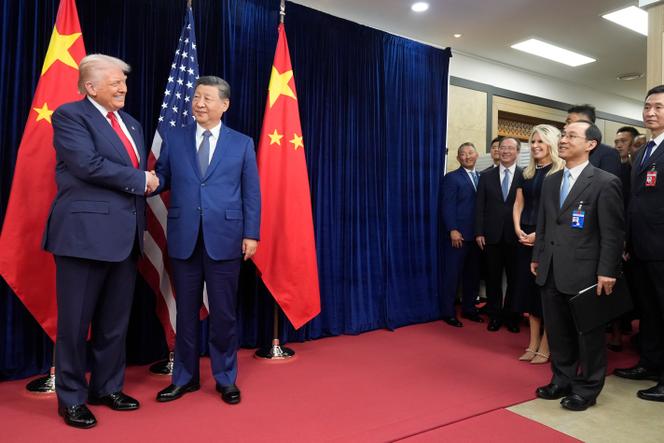
With Donald Trump, there is always a gap between the effusive adjectives he uses and reality, which is inevitably more complex. The president of the United States described his meeting with his Chinese counterpart, Xi Jinping, on the sidelines of the Asia-Pacific Economic Cooperation summit in South Korea, on Thursday, October 30, as “outstanding.” He boasted, “On a scale from zero to 10, with 10 being the best, I would say the meeting was a 12.” The Chinese president did not engage in this sort of evaluation, but he could have easily claimed to have achieved a far higher score, given the way he managed to rebalance the power dynamic between the two countries to his own advantage.
While the meeting marks a respite in the US-China trade war, it mostly showed that Trump had overestimated his leverage, as he sought to bring Beijing to heel from the first demand. It only took one threat from China, on imposing export restrictions on rare earth elements, for the US to realize that Beijing, too, could assert its strategic interests, even in the face of the world’s leading power.
China controls 60% of the capacity to extract these minerals, which are essential for digital technologies and the defense industry, and 90% of refining capacity. This has given Beijing enormous leverage to disrupt global supply chains in some of the world’s most strategic sectors. After having threatened Beijing with 100% tariffs, Trump was ultimately forced to lower his tone and try a more conciliatory approach.
Trump cards
In exchange for China suspending new export controls on rare earths for one year, the US not only agreed not to impose new tariffs but also accepted reducing existing tariffs, in return for a vague commitment from Beijing to fight fentanyl trafficking.
American tariffs on Chinese imports were reduced to 45%: Still high, but hardly insurmountable. China’s economic competitiveness remained formidable, and Beijing had demonstrated its adaptability by diversifying its trade relationships to lessen its dependence on the US. The issue of US restrictions on exporting microprocessors, which are crucial for the growth of artificial intelligence technology, remained unresolved, but dialogue on the issue had not broken down. For good measure, Xi agreed to resume purchases of American soybeans, which he had completely halted earlier in the year, causing significant losses for US farmers.
Soybeans and rare earths are two trump cards that Xi can play at will. Rare earths, in particular, pose a constant threat, as it would take the US years to achieve strategic autonomy in this area.
At this stage, there is neither a winner nor a loser. Yet it is clear that Trump had underestimated his adversary. This setback should prompt him to rethink his strategy. Until now, he had not seen the need to rely on his European and Asian partners to counter China, instead preferring to humiliate them by using the same strong-arm tactics he employed with Beijing. In the face of China, which has proven more powerful and cunning than he expected, the US would be better off trying to build a united front. That would require a dramatic change in attitude toward those with whom it is supposed to be allied.
Fonte: Le Monde