


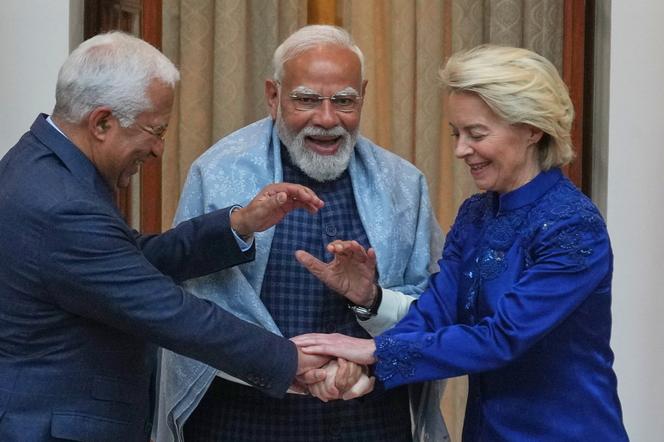
“We have concluded the mother of all deals,” announced Ursula von der Leyen on X on Tuesday, January 27, as India and the European Union wrapped up negotiations on a free trade agreement. The Commission president, along with her counterpart from the European Council, Antonio Costa, traveled to New Delhi to mark the creation of a market encompassing nearly two billion people and the commercial union of two continents, which together account for a quarter of global gross domestic product.
This agreement between the world’s second- and fourth-largest economies must now be formalized legally before being ratified by the member states and by the European Parliament. Burned by the precedent set by the Mercosur deal – which faced fierce opposition in Paris and deeply divided the European Parliament – the Commission, which negotiates on behalf of the 27 member states, was careful to avoid controversy. For example, the most sensitive agricultural products, such as beef, rice, soybeans and dairy, were excluded from the talks. The Commission also refused to give in to pressure from New Delhi, which wanted an exemption from the EU’s carbon border tax, particularly for Indian steel, which it exports in large quantities to Europe. According to the Global Trade Research Initiative, a New Delhi-based think tank, this remains an unresolved issue.
You have 76.8% of this article left to read. The rest is for subscribers only.
Fonte: Le Monde